After Holyoke
Joseph Philorum Oligny and Marie-Anna Saurette married at Holyoke on 30 May 1912. The marriage lasted nearly ten years. What came after — a conviction, two separate court actions five years apart, two rebuilt households, a name change built on a story that wasn't true, and sixty-seven more years for Marie-Anna alone — has always existed on this site, scattered across half a dozen profile pages. This page is where it lives as one story.
1912–1916: A marriage, two children, a conviction
Joseph P. Oligny, twenty-two, and Marie Anne Saurette, twenty-one, married at Holyoke on 30 May 1912, solemnised by Rev. Jos. Marchand. The parish was Notre-Dame du Perpétuel-Secours, and the witnesses were Victor Leclerc and Alméric Saurette, the bride's own father. Both gave Canada as their birthplace and a Holyoke street address; he worked as a casemaker, she as a mill operative. Irene was born 30 April 1913; Roland, 19 November 1915, both at 75 Front Street.
On Tuesday 18 July 1916, Joseph was convicted of assaulting his wife and sentenced to three months. Two days later, a newspaper reported that Marie-Anna would now sue for divorce with separate support for herself and her two children.
She was twenty-five, with a three-year-old and an eight-month-old.
Marriage certificate no. 199 & register, City of Holyoke, 1912 · birth registers, Holyoke, 1913 & 1915 · newspaper report, 20 Jul 1916 · graded Proven
1916–1922: Two petitions, five years apart
What Marie-Anna actually filed, and when, took this project a long time to get right, and it's worth showing the correction rather than hiding it. The 1916 action was not a divorce. It was a petition for separate support — Hampden County Probate Court, case 39079, docket 33, page 116 — a distinct Massachusetts remedy that orders money and settles custody without dissolving a marriage. The pleading recites, almost word for word, the statute's own grounds: that her husband fails without just cause to furnish suitable support for her, and has deserted her and that she is living apart from him for justifiable cause.
The dates on the file itself tell the week better than any summary of it. She signed the petition on Monday 17 July 1916 — the day before he stood in court and was convicted of assaulting her. Two days after that conviction the newspaper carried her intention to sue for divorce. She filed the petition on Thursday 27 July, nine days after the conviction and a week after the newspaper. So it wasn't a decision taken in the aftermath: the paperwork was already written and signed before the assault case was heard, and what she filed in the end was the narrower remedy, not the one she'd told the press about.
The printed form leaves a block of ruled lines for specifications — the detailed grounds. She left them blank. Desertion and non-support, and nothing further on the record. She signed it Anna Oligny
, not Marie-Anna. Stapleton & Stapleton appeared for her; the line for the respondent's counsel is empty.
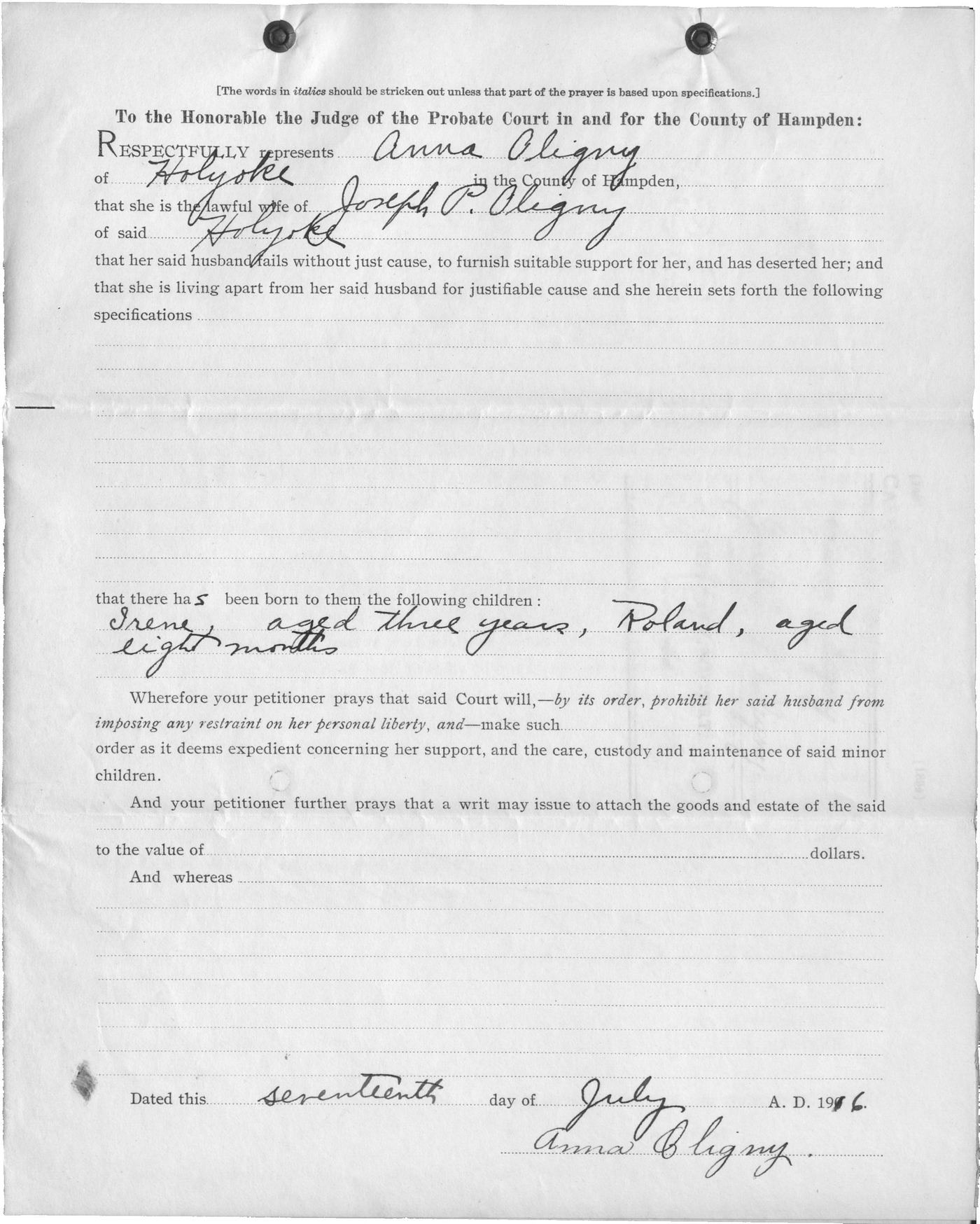
Petition for separate support, Anna Oligny v. Joseph P. Oligny — Hampden County Probate Court, case 39079, signed 17 July 1916. PROVEN
The evidence here is the empty space. The form invites her to set out her specifications — the particulars, the dates, what he did — and gives her eleven ruled lines for it. She used none of them. What stands on the record is the printed allegation and nothing else: desertion, non-support, living apart for justifiable cause. Whether that was her lawyer’s economy, her own reticence, or a decision about what she was prepared to put in writing about her marriage, the paper does not say, and neither does this site.
What she did write out in full is the part about the children — Irene, aged three years, Roland, aged eight months — and that is correct to the month against Roland’s birth on 19 November 1915. She signed it Anna Oligny, six years before she would sign a New York affidavit the same way.
One detail runs against her. The instruction at the head of the form says the italic words are to be struck out unless specifications support them — and the italic prayer asking the court to restrain her husband from interfering with her personal liberty stands unstruck above eleven blank lines. That is loose form-filling rather than a claim, and it is noted here for the same reason the overstruck year below is: what is on the paper is what gets reported. Why this site shows some documents and not others.
No decree is recorded against this docket. The Allowed line is blank, the volume and page for recording are blank, and the draft decree in the file was never filled in or signed. What she asked for at twenty-five was money and her children — whether the court ever granted it isn't shown by anything in this file.
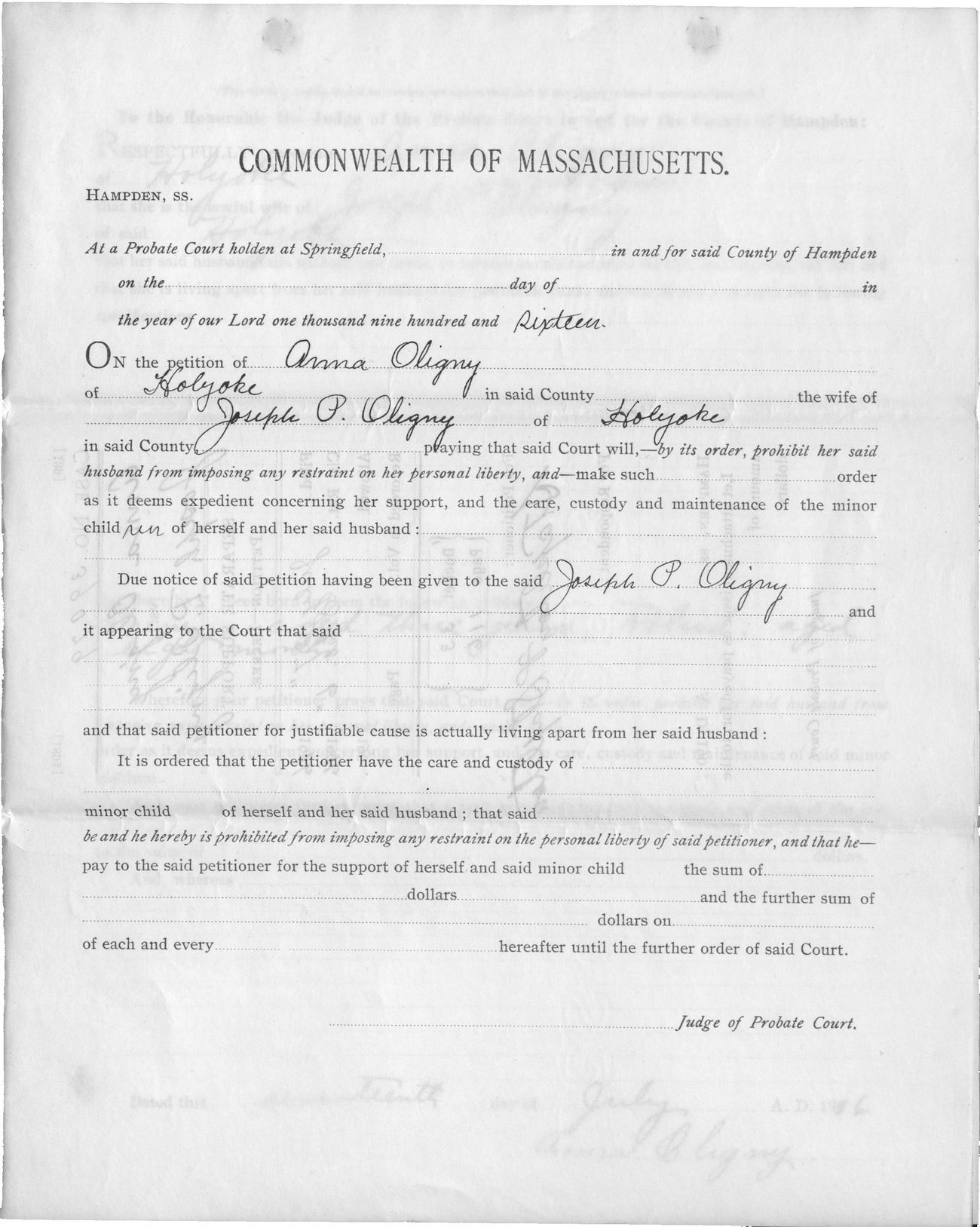
The draft decree in the same file — prepared, and never completed. UNPROVEN as to any order ever made.
This is not a blank form. Somebody filled in everything that could be known before a hearing — both names, both residences, the year Sixteen, and the recital that notice had been given to Joseph. Then it stops. The day of the sitting, the court’s finding, the custody clause, the sum he was to pay and the day of each month he was to pay it are all empty, and the line at the foot for the Judge of Probate Court was never signed.
So the file does not say the court refused her. It says the court never reached her. Whether anything was ordered is not shown by anything in this docket, and the blanks are the reason this site records the 1916 action as a filing rather than as an outcome. Her freedom came five years later, from a different court and a different case.
The freedom came five years later, from a different filing entirely. On 18 March 1921, Marie-Anna libelled Joseph for divorce at Hampden County Superior Court, docket no. 1673 — not on the 1916 desertion ground, but on cruelty and gross and confirmed habits of intoxication,
alleging conduct as recent as August 1920. Decree nisi was entered on 5 July 1921; under the printed form's own terms it became absolute six months later absent cause shown, and a certificate of the court — issued the following morning, and filed a year afterwards inside her New York marriage licence as proof that she was free to marry — puts that day at 5 January 1922. The docket jacket's own note, Finished February 6, 1922,
is the clerk clearing the case a month later, not the decree taking effect. Custody of Irene and Roland was awarded to Marie-Anna outright. The line offering to restore her maiden name was struck through and left blank; she remained, on the decree, Anna Oligny. One law firm, Stapleton & Stapleton, represented her in both actions, five years apart.
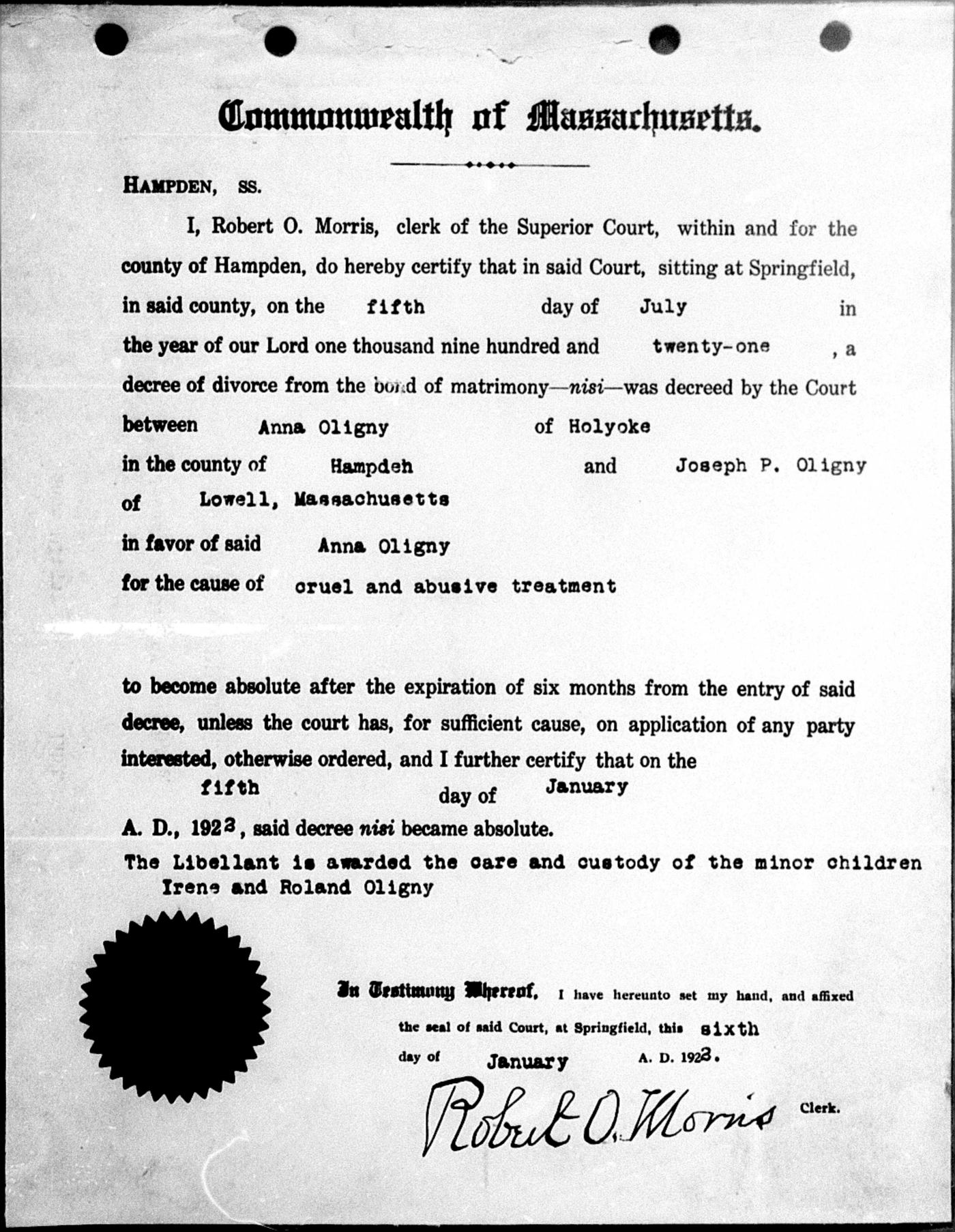
Certificate of Divorce, certified by Robert O. Morris, Clerk of the Superior Court at Springfield — issued 6 January 1922, the morning after the decree took effect. PROVEN as to the decree, which the complete case file independently holds.
This is the document that corrected this site. The date the divorce became absolute had been given here as early February 1922, on the strength of a note on the docket jacket reading “Finished February 6, 1922” — which turns out to be the clerk closing the case a month afterwards. Nobody had gone looking for a certificate, because nobody expected one to exist; it is here only because New York required the bride to prove she was free to marry, so it sits inside a licence file in another state. See Corrections.
Look at the year, and then do not trust it. Both typed year-digits on this sheet are struck over — a 2 and a 3 on one strike — and on their face they are genuinely ambiguous. The date is 1922, settled three independent ways off the document itself: the decree it certifies was entered 5 July 1921 and the same sheet says six months; the licence it is filed inside was issued in April 1922; and the case file carries the entry. The overstrike is left visible here rather than tidied away, which is the same reason nothing else on these pages is retouched. Why this site shows some documents and not others.
Separate support case file, no. 39079, Hampden County Probate Court, petition dated 17 Jul 1916 and filed 27 Jul 1916, docket 33 p. 116 — sighted · newspaper report, 20 Jul 1916 (S53) · divorce case file, docket 1673, Hampden Superior Court (S82) · graded Proven throughout — two distinct proceedings, not one delayed conclusion
Why the marriage failed — what the record says, and where it stops
A reader who has followed the two petitions above will want the question the documents keep circling and never answer: what went wrong. The honest reply is to draw the line exactly where the paper draws it, because this site does that for every other question and has not, until now, done it for this one.
What the record gives. A conviction for assault on his wife, 18 July 1916, and a three-month sentence. A petition for separate support signed the day before that hearing, pleading desertion and non-support in the statute's own words, with the eleven ruled lines for particulars left blank. A libel for divorce five years later, in March 1921, on different grounds — cruelty, and gross and confirmed habits of intoxication — alleging conduct as recent as August 1920. A decree nisi that July, custody of Irene and Roland to her, and an alimony line that is blank on the decree as it survives — which does not mean none was ordered. That is the whole of what any court was told, and nearly all of it was pleaded by one side, in the form the law required.
What the record does not give. No account from either of them, in their own words, of what happened in that house. No testimony, no affidavit beyond the printed pleading, no letter. Nothing that says what Irene, three, and Roland, eight months, were told then or later, and nothing that says whether they saw their father again after he went to Lowell. No adoption record has been located, and the 1930 census enters both children as Gideon Rock's step-children, under the name they were born with. The silence on these pages about the cause of the marriage's failure is not an omission. It is what the file holds.
Two later documents bear on the children, and it is worth stating exactly what they show. When Joseph died in March 1966, the notice his household gave the Lowell Sun listed his survivors — two daughters, Mrs. Bernard Tetreault of Holyoke, Irene, among them, and two sons, Roland Oligney of Holyoke and Dewey. When his widow Leonida died in October 1968 the household did it again: stepson Roland Oligney of Holyoke, stepdaughter Mrs. Bernard Tetreault. Two of the two Lowell notices from that household with occasion to name him, forty-four and forty-six years after the divorce and nearly three decades after Roland had sworn to a probate judge that Joseph was dead, counted his first two children among their own, under the surname he had given them. That is what an obituary can show: who a family named when asked. It does not show contact, or visits, or anything about the years between, and this site does not read those into it.
Newspaper report, Springfield Republican, 20 Jul 1916, for the conviction and sentence · separate support petition, Hampden Probate case 39079, 17 Jul 1916, sighted · divorce libel and decree, Hampden Superior Court docket 1673, 1921, sighted · 1930 U.S. Census, Chicopee · obituaries of Joseph P. Oligney, Lowell Sun, 17 Mar 1966, p. 2, and of Leonida (Perreault) Oligney, Lowell Sun, 21 Oct 1968 — authored notices from family information, primary as to the survivors they name · Register 01 §3.25a, §3.52, S304, S246 · graded Proven as to the documents’ content; the cause of the marriage’s failure is not a graded claim on this site, and the two obituaries are read for the names they give and nothing further
Two households, rebuilt separately
Joseph was at Lowell by the spring of 1921 — the July decree styles him of Lowell, Massachusetts,
and Marie-Anna swore he had been served there in the action she filed that March. The city directories do not record the move until their 1922 volume, a canvass taken months before the year stamped on it and catching up rather than reporting. He is in Lowell for the rest of his life. He remarried — Leonida, born in Maine, a spinner at the Boott Mills — by about 1930 or 1931; their children Lucille and Dewey were born around 1932 and 1936. His widowed mother, Azilda Bessette, lived in his household as late as 1940. On a 1940 federal form he gave his own birthplace as Massachusetts. It wasn't true — he was born at St-Rémi, Québec — and his first wife's own household had already given the correct answer, on a census taken a decade earlier, without being asked to correct him.
Marie-Anna's second marriage, to Gideon Rock, is now on its own original record, after years of turning up nothing in Massachusetts: 27 April 1922, at the Municipal Building in the Borough of Manhattan, solemnised by J. J. McCormick, Deputy City Clerk, with F. E. Waterman and Thos. J. Douglas signing the return as witnesses. A civil ceremony, not a parish marriage, and for a plain reason: Joseph was still alive, and a Catholic divorcée could not remarry in the Church while her first husband lived. Licence file no. 10891 holds three instruments — the affidavit both of them swore and signed that morning, the licence issued the same day, and the clerk's own return of the ceremony. Marie-Anna is entered as Anna Oligny, exactly as the decree left her, since her maiden name was never restored; both parties gave their residence as 61 High Street, Holyoke, and both gave their age as thirty-one, which both of them were. She gave her occupation as Spinning. Gideon was born at Holyoke on 23 December 1890, a barber for many years at the Hotel Roger Smith, and a WWI veteran of the U.S. Army Medical Corps. In the 1930 census, Roland and Irene are recorded in the Rock household as step-children, still under the Oligny surname.
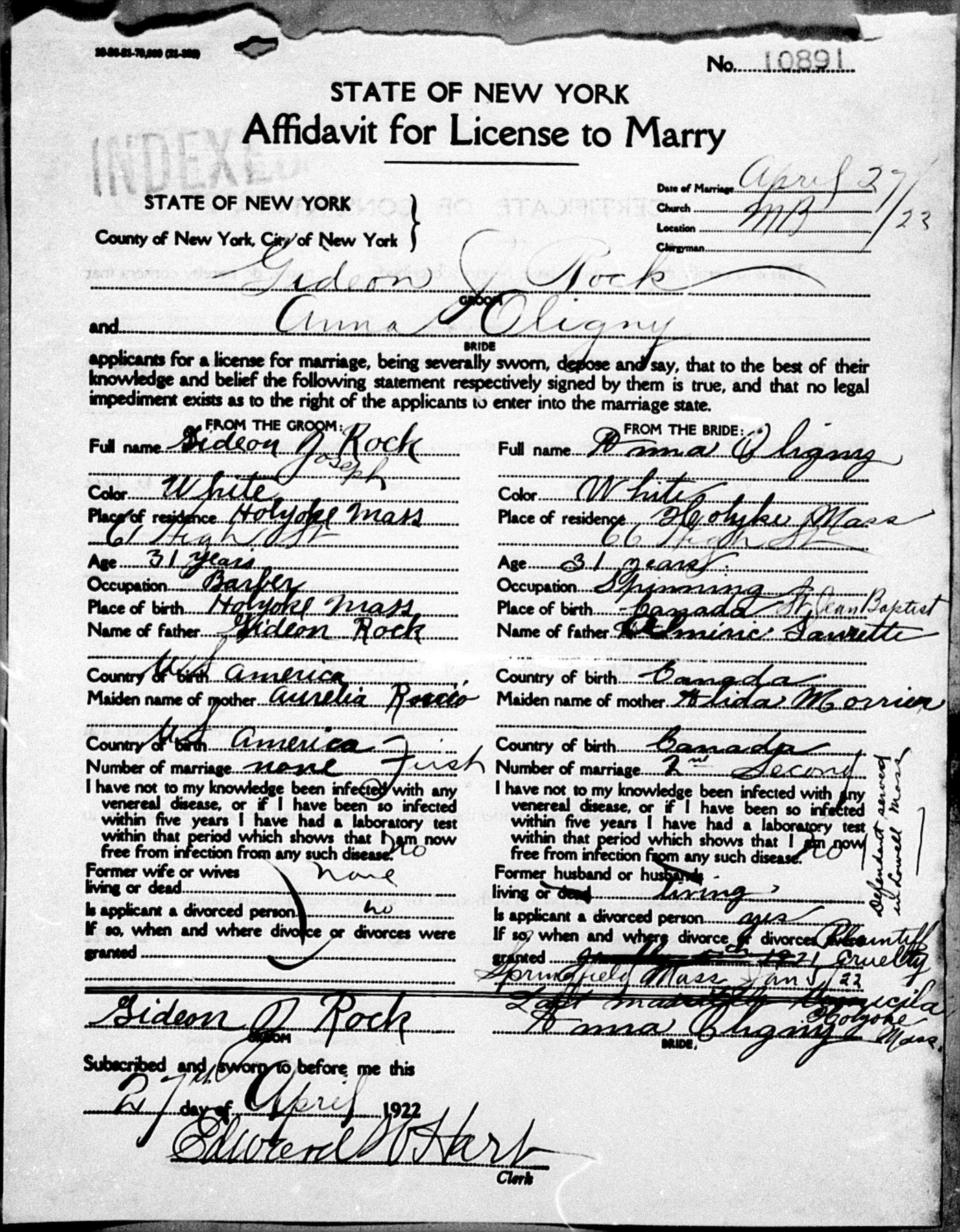
Affidavit for License to Marry, State of New York, no. 10891 — sworn and signed by both of them at the Municipal Building on the morning of 27 April 1922. PROVEN; the particulars are the parties’ own.
Read the two columns against each other. Both give the same address, 61 High Street, Holyoke, and both give their age as thirty-one, which both of them were. He is a barber and enters first marriage; she enters second, answers yes to whether she is a divorced person, and names Springfield and the cause. Her occupation is Spinning. She signs, as she signed everything after 1921, Anna Oligny — the decree had struck through the line offering to restore her maiden name.
One answer on the groom’s side is wrong. Asked his father’s country of birth he says America; Gideon’s own page traces that line back to Quebec. It is the kind of error a man makes about a generation he did not witness, entered on oath, and it is recorded here rather than passed over. The certificate above is filed with this sheet because of the bride’s answer in her fourth-from-last line.
1930 & 1940 U.S. Census · WWII draft registration, Joseph Philorom Oligny · Richard Ernest Rock's 1929 birth return · New York City Clerk marriage licence file no. 10891, 27 Apr 1922, Manhattan — affidavit, licence and officiant's return, sighted · Certificate of Divorce, Hampden ss., Superior Court at Springfield, certified 6 Jan 1922, filed in the same licence file, sighted · Register 01 §3.30f · graded Proven; the two witnesses are graded Probable as clerk's-office staff, and no record has been sought for either
1937: A name, and a story that wasn't true
In December 1936, applying for a Social Security number, Roland was already using Roland Rock
as an alias against a legal name still Oligny — and named his father, on that federal form, as Philorum Oligny.
Four months later, on 22 March 1937, he petitioned the Hampden Probate Court to make the name legal, swearing in his own petition:
«...that he wishes to change his name to that of Roland Rock, for the reason that his father died shortly after his birth and his mother married one Rock whose name the said Roland Oligny has since used. In order to keep his Social Security record straight he wishes to legally bear the name of Roland Rock.»
Neither claim in that stated reason is true. Joseph Philorum Oligny did not die shortly after Roland's birth — he lived another twenty-nine years, to 1966. The first marriage ended not in death but in divorce, filed when Roland was about five, not an infant. Roland, at twenty-one, swore a false account of his own father's fate to a probate judge. The petition was allowed on 23 April 1937, unopposed, published three weeks running in the local paper.
Why he said it is not established, and this site does not pretend otherwise. What the documents allow is narrower, and worth setting out in one place. The reason that holds up on its own is the administrative one, and it is now on paper at both ends. Social Security registration had opened in November 1936, and on 2 December Roland filled in the first federal identity form of his life, writing two surnames in one box — OLIGNY (ROCK) — and signing it Roland Rock, because neither name alone was true. One hundred and ten days later he asked a judge to reduce them to one, and the petition says so in as many words: in order to keep his Social Security record straight. That reason needed no dead father to carry it; a young man who had gone by Rock for years had an entirely undramatic case. So the false sentence is not what got him the name. It is the thing in the petition that the petition did not need.
Two facts sit either side of it, and neither is evidence of intent. On the December form he named his father in full, Philorum Oligny; on the March petition that father had died in infancy. The interval is a fact and it is worth having. But the form asked who, not whether — it has no field for a parent being alive — so naming Joseph on it is entirely compatible with believing him dead, and nothing in either document tests what Roland believed. The same petition also gets his birth year wrong by one and recites that he had lived in Holyoke only, against a census and a school record that put him in Chicopee; its recitals were not carefully made, and a lawyer's clerk may have typed more of it than Roland dictated. Beyond that the candidates are what they have always been on his own page: a household that had spoken of itself as Rock for years, writing its habit down; the easier thing to put on a form; or a decision. None is established.
There is one more thing, and it comes from inside the family rather than from paper. Roland's own son Robert, asked about the name change, offered a possibility and hedged it himself: that Roland may have believed his father was dead when he signed — that he could have been told so as a child — and that he did not know. It is recorded here as exactly that, a witness's conjecture, not a recollection, and nothing is built on it. It is also the only account that would make the sworn sentence sincere though wrong, and told-as-a-child is precisely how such a belief would arrive in a house Joseph had left when the boy was five. Nothing extant is likely to test it either way.
Social Security application, Dec 1936 · petition and decree, Case No. 68419, Hampden Probate Court, 22 Mar & 23 Apr 1937 · family testimony, recorded for this project in 2026 — Robert, son of Roland, on whether his father believed Joseph dead, offered as a possibility and hedged by the witness himself · Register 01 §3.26a · Oral History Register §2.6(c) · graded Proven as to the documents' content; the reason behind the false claim is Unproven, and the testimony is a witness's conjecture, recorded and not built on
What outlived them
Gideon Rock died at the Holyoke Soldiers Home on 20 October 1961, aged seventy. His obituary named Marie-Anna as his wife, and named Roland, Donald, and Richard as his sons, Irene as his daughter — no distinction drawn, thirty-one years after a census had called the same two children step-children, and twenty-four years after a probate court had made one of them legally his in name only. Three documents, thirty-one years, three different ways of describing the same relationship. None of them was wrong. Each recorded the answer somebody gave at the time it was asked.
Marie-Anna outlived him by seventeen and a half years, dying at Holyoke on 13 May 1979. Her death certificate names her Anna M. Saurette Rock. She had, by then, survived both husbands she'd had by law — one who deserted her at twenty-five and was still alive somewhere in Lowell when she buried the second.
Gideon Rock obituary, Oct 1961 (S46) · Marie-Anna's death certificate, 1979 (R1 §3.29) · graded Proven
Roland himself died nineteen years later, on 29 October 1998, at a Chicopee nursing home, aged eighty-two — a quality control inspector for thirty-three years at the Moore Drop Forge Co., an Army veteran of the Second World War, and by then a father of six: four sons and two daughters not otherwise named anywhere in this project's own records until this obituary. They aren't named here either — this project stops at the generation still living, deliberately, not for lack of a source. His wife, Helena — recorded on the census and elsewhere in this file only as "Helena C." — is named in full here: Helena Williams, matching what her own 1938 marriage certificate already gave in full and this page's shorthand had dropped. And the obituary offers a clean, independent check on something this project had already worked out from the 1950 census: two men named Richard, one Roland's own son, one Marie-Anna's son and Roland's half-brother, easy to conflate in a family already this tangled with names. The obituary lists them a line apart and just as unmistakably separate — Richard of Ludlow
among Roland's own children, a brother, Richard, of Belchertown
lower down — agreeing with the census without either document having been written with the other in mind. Roland's own middle name gets a small footnote here too: Lawrence on the 1915 birth register, in the clerk's hand and nowhere else in his life; Alberic typewritten on a 1936 federal form, which he signed simply Roland Rock; Albert on the form he signed in 1940 and kept from then on — and, nearly sixty years after that, a bare L.
heading his own obituary. Whether that's Lawrence quietly resurfacing at the very end or simply an initial nobody today can account for, this project doesn't know — see Roland's own page for the full sequence. A fourth form, Albini, stood here as his baptismal name until 30 August 2026 and was withdrawn as unsourced; the parish's own extrait baptistaire has since turned up in the family's papers and does spell it that way, against Alberic in the same parish's published répertoire. This site follows Alberic, on the godfather's name, and the grade stays Probable (see Corrections).
Obituary, Roland L. Rock, Sunday Republican (Springfield Union-News), 1 Nov 1998 · graded Proven
Nothing about this family's paper trail was tidy, and none of it pretends otherwise on this site. A court that gave a woman money and her children but not her freedom in 1916, and her freedom five years later on entirely different grounds. A man who told the government he'd been born somewhere he hadn't. A son who told a judge his father was dead when he wasn't, to get a name he'd already been using for years. None of it was hidden — it was written down, by the people living it, at the time. The record didn't need help condemning or forgiving any of them. It just needed reading in order.