Roland Rock
b. 19 November 1915, Holyoke — d. 29 October 1998. Four documents give him three different middle names, and five give three different answers to who his father was. He appears in a court petition at eight months old, in a divorce libel at five, and in a petition of his own at twenty-one — and he is the one person in whom the two lines this site follows finally meet.
Four names, and none of them agree
Roland was born on 19 November 1915 at 75 Front Street, Holyoke, second child of Joseph Philorum Oligny and Marie-Anna Saurette. The city's register enters both parents as born in Canada and his father's occupation as millwright — and gives the father's middle initial as T rather than P, a clerk's slip on a page of forty-five births.
The name is the thing worth following. Four documents name him and between them give three different middles — and a fifth form, the one this site carried longest, turns out to be the parish's own reading of one of the four:
Joseph Roland, footnoted Alberic — the baptism, 20 November, the day after the birth, at Notre-Dame du Perpétuel-Secours by Rév. Joseph A. Marchand, the priest who had married his parents in the same church three years earlier. His sponsors were Albéric Saurette, his mother's own brother, and Florence Trudeau, the woman that brother later married. The child was given his godfather's name. This comes from the published parish répertoire rather than the register itself, so it is graded Probable — an index of the act, not the act.
Roland Lawrence Oligny — the civil birth register, entry 1461. An English middle name in the clerk's hand, on a page where his parents' birthplaces are both entered as Canada. It is the only time Lawrence is written out in his life.
Roland Alberic Rock, over a surname field reading OLIGNY (ROCK) — the Social Security application. Alberic is typewritten; the signature at the foot of the same form reads simply Roland Rock.
Roland Albert Rock — the draft registration, which he signed in that form. Alberic has become Albert, and stayed there.
Joseph Rolland Albini — carried on this site until 30 August 2026 as his baptismal name, and the form the parish itself writes. An extrait baptistaire issued by Notre-Dame du Perpétuel-Secours renders the footnoted name Albini; the same parish's published répertoire renders it Alberic. Two readings of one act, and they disagree. This site follows Alberic, because the sponsor named at the font is Albéric Saurette — Marie-Anna's brother, this child's uncle — and a child named for his godfather carries the godfather's name. See Corrections.
The sequence this site withdrew in August 2026 has most of itself back, and the first term is not the one anybody expected. Alberic stood at the head of it — not as a fourth name but as the name of the uncle holding him at the font, written into the parish book the day after he was born. From there it runs unbroken: Alberic at the baptism in 1915, Alberic typewritten in 1936, Albert signed in 1940 and kept for fifty-eight years. One name shedding its French across a quarter-century, in a family that had been naming children after their godparents for three generations. What sits outside it is the English middle name the city assigned him at birth: Lawrence, once, in 1915, in a clerk's hand — never written out again by anyone, including him.
Births Registered, City of Holyoke, 1915, p. 153, no. 1461 · Form SS-5, Social Security application, signed Holyoke 2 Dec 1936, obtained from the Social Security Administration under the Freedom of Information Act · WWII draft registration, D.S.S. Form 1, serial 1220 · published parish répertoire, Notre-Dame du Perpétuel-Secours, Holyoke, baptisms 1890–1991, compiled · Register 01 §3.48, §3.49(iv) · graded Proven as to the three civil and federal documents; the baptism and the name Joseph Roland · Alberic graded Probable, resting on an index of the register rather than the act · the form Albini is the parish's own extract's reading of the same act, graded Probable with it; where the two readings differ this site follows Alberic, on the sponsor
Named in the paperwork before he could read it
Roland enters the legal record of his parents' marriage three times before he was old enough to know it was happening. In July 1916 he is one of two children named in Marie-Anna's petition for separate support — entered as eight months old, against his sister Irene at three. In January 1920 the census still finds the household together at Holyoke, Roland aged four. And in March 1921 he is named again, with Irene, in the divorce libel his mother filed at Hampden County Superior Court; when the decree nisi was granted that July, custody of both children went to her.
He was five. Nothing in the record suggests he was ever asked about any of it, and nothing in the record tells us what he was told.
Separate support case file no. 39079, Hampden County Probate Court, 17–27 Jul 1916, sighted · 1920 U.S. Census, Holyoke Ward 1 · divorce case file, docket no. 1673, 1921 · graded Proven
A second household, and a name he used before it was his
Marie-Anna remarried — to Gideon Joseph Rock, a Holyoke barber, at Manhattan on 27 April 1922, sixteen weeks after the divorce became absolute on 5 January. By April 1930 the household on John Street in Chicopee holds four children: Irene at sixteen and Roland at fourteen, entered as step-children and still carrying the surname Oligny; and Donald and Richard, the two sons Marie-Anna and Gideon had together.
One small detail on that census page is worth pausing over. Whoever answered the enumerator's questions distinguished the two fatherhoods exactly right: Donald's and Richard's father entered as born in Massachusetts, Irene's and Roland's as Canada-French. Fourteen years after Joseph left, that household still knew precisely where he came from, and said so to a stranger at the door.
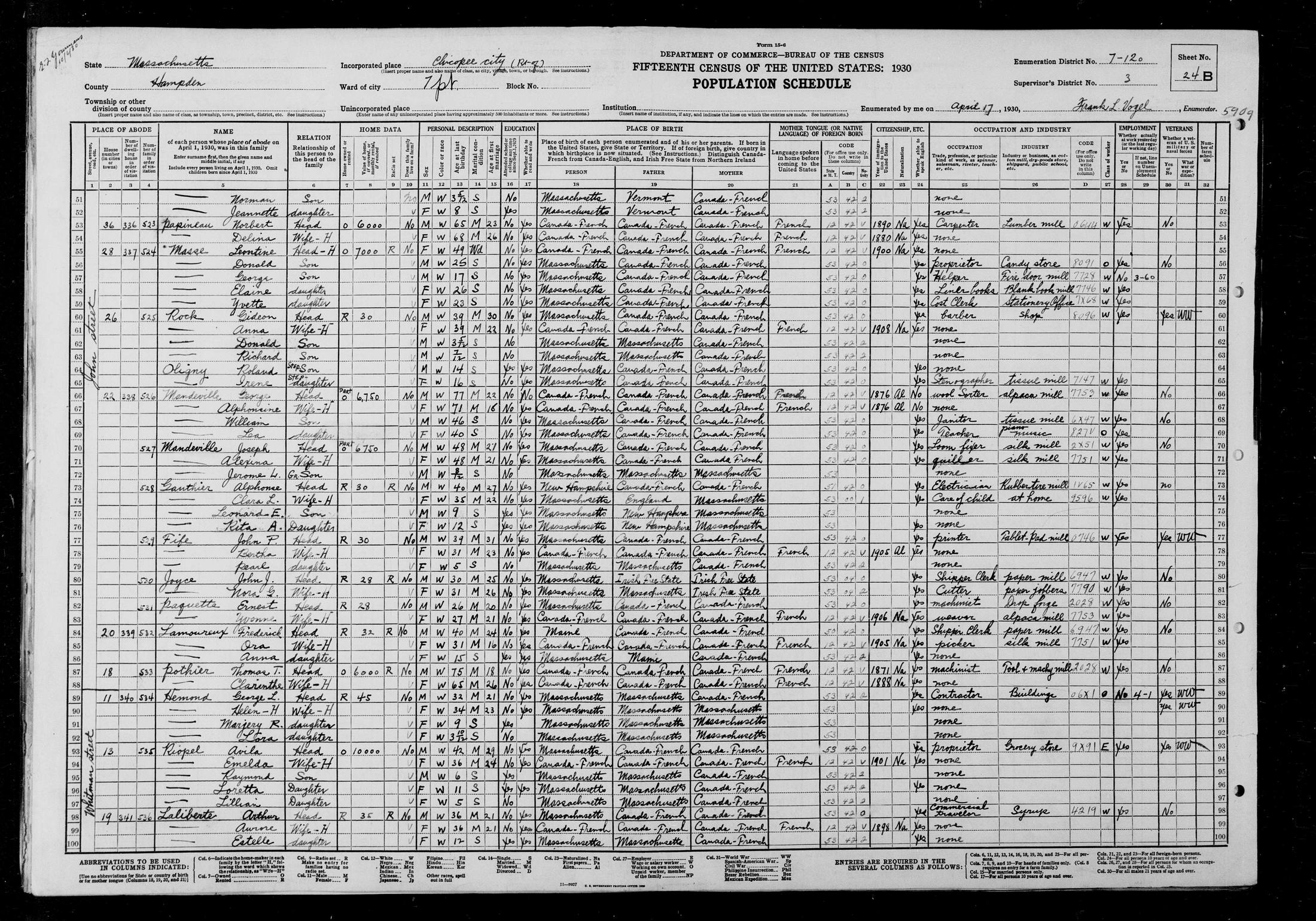
Fifteenth Census of the United States, 1930 — Chicopee, ward 7, sheet 24B, John Street, house 26, family 525; enumerated 17 April 1930 by Frank L. Vogel. PROVEN as enumerated — every field on it is a household’s answer to a stranger at the door.
The whole sheet is here and the household is six lines of it, halfway down. It is worth opening the image to read them. The surname changes partway through the family: four Rocks, then Oligny written afresh for Roland — step-son and Irene — step-daughter. Seven years before a probate judge made it official, the census had them under the name they were born with and the household they actually lived in, and recorded both without difficulty.
The column to look at is the father’s place of birth. For Donald and Richard it reads Massachusetts. For Roland and Irene it reads Canada-French. Somebody in that house answered a stranger’s questions about two sets of children by two different men and got every field right — including the birthplace of a father who had left fourteen years earlier and would, ten years after this, tell a federal enumerator of his own that he had been born in Massachusetts. His first wife’s household had already given the correct answer, without being asked to correct him.
Four ages on these six lines are exact to the month against birth dates proven elsewhere. The Rocks rented at thirty dollars a month; the neighbour two doors down owned a house worth seven thousand. Why this site shows some documents and not others.
1930 U.S. Census, Chicopee, Ward 7, E.D. 7–120, sheet 24B · graded Proven
December 1936: the form that came first
The order of the next two documents is the whole point, and it is easy to get backwards.
On 2 December 1936, Roland applied for a Social Security number. Numbers had only begun to be issued the month before. On that application he gave his father as "Philorum Oligny" — his father's own middle name, the name the man went by — and his mother as Anna Saurette. In the box asking for his last name the form carries both of his: OLIGNY (ROCK), the legal one first with the used one in parentheses beside it. At the foot of the form, where it asks for the signature as usually written, he signed Roland Rock — no middle name, no initial.
So in December 1936 he named his living father to the federal government while entering himself under two surnames at once, because neither one alone was true. One hundred and ten days later he asked a probate judge to reduce them to one, and the petition says so in as many words: in order to keep his Social Security record straight. This form is the record it means. The answer he gave here about his father is one he never gave again.
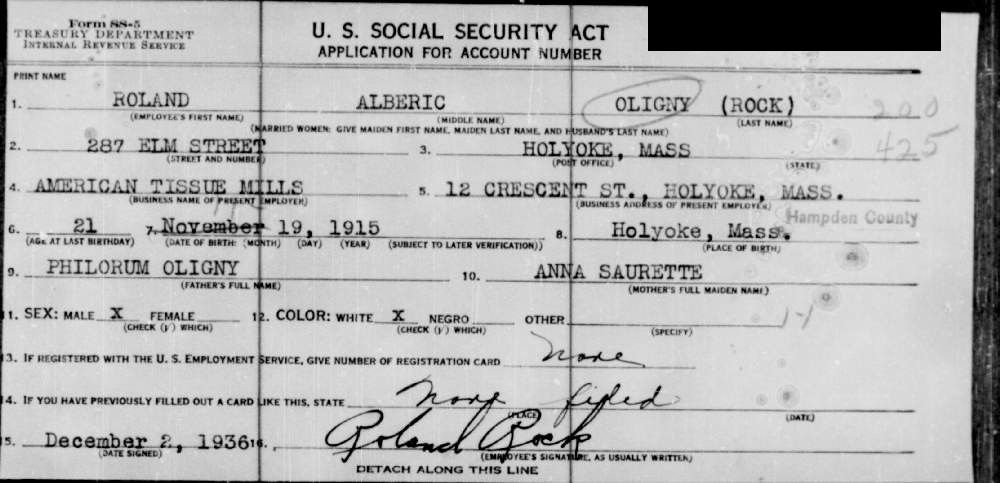
Form SS-5, application for a Social Security account number — signed at Holyoke, 2 December 1936, and obtained from the Social Security Administration under the Freedom of Information Act. PROVEN as to what the applicant reported.
What to look at is item 1 and item 16. The last-name box holds two surnames, OLIGNY (ROCK); the signature line, which asks for the name “as usually written,” holds one, Roland Rock, with no middle name and no initial. The body is typewritten. Only three marks on the sheet are in Roland’s own hand — none at item 13, none filed written across both sub-lines of item 14, and the signature.
Item 9 does not read as plainly as it looks. The form gives the father’s name as PHILORUM OLIGNY, unqualified — and Roland’s grandfather was a Philorum Oligny who filed his own SS-5 in the same month. The man named here is Joseph Philorum Oligny, by his middle name, which is settled elsewhere by his own signature in 1917 and again in 1942, not by this document.
Two things on the sheet are later hands, not evidence: the pencil ring around OLIGNY and the pencil figures in the right margin. They are described here and not interpreted. The account number has been removed from the image — blacked out in the pixels rather than covered over, so it cannot be recovered from the file. It was a clerk’s entry rather than Roland’s, so nothing the form proves depends on it. Why this site shows some documents and not others.
Form SS-5, application for a Social Security account number, signed Holyoke 2 Dec 1936 — obtained from the Social Security Administration under the Freedom of Information Act · Register 01 §3.26a · graded Proven as to the applicant's self-report. The Social Security NUMIDENT, an index abstract of this form, was this site's source until 30 August 2026 and is superseded by the form itself — see Corrections
March 1937: what he told the court
On 22 March 1937, aged twenty-one years, four months and three days, and working as a trucker, Roland petitioned the Hampden County Probate Court to change his name legally to Roland Rock. His stated reason is exactly the mismatch above: he wanted it "in order to keep his Social Security record straight." The citation ran three weeks in the Holyoke Daily Transcript and Telegram, nobody appeared to object, and Judge John A. Denison allowed it on 23 April 1937 — by which date, thirty-two days later, he was twenty-one years, five months and four days old.
The petition also explains how he came by the name he was born with, and that part is false:
…for the reason that his father died shortly after his birth and his mother married one Rock whose name the said Roland Oligny has since used.
Joseph Philorum Oligny did not die shortly after Roland's birth. He was alive in Lowell that week and lived another twenty-nine years. The marriage did not end in death; it ended in a divorce filed when Roland was five. And three months earlier, Roland had named that same father, in full, on the application this petition exists to tidy up.
He signed the petition "Roland Oligny," in his own hand. It is the last time that name appears on anything he wrote.
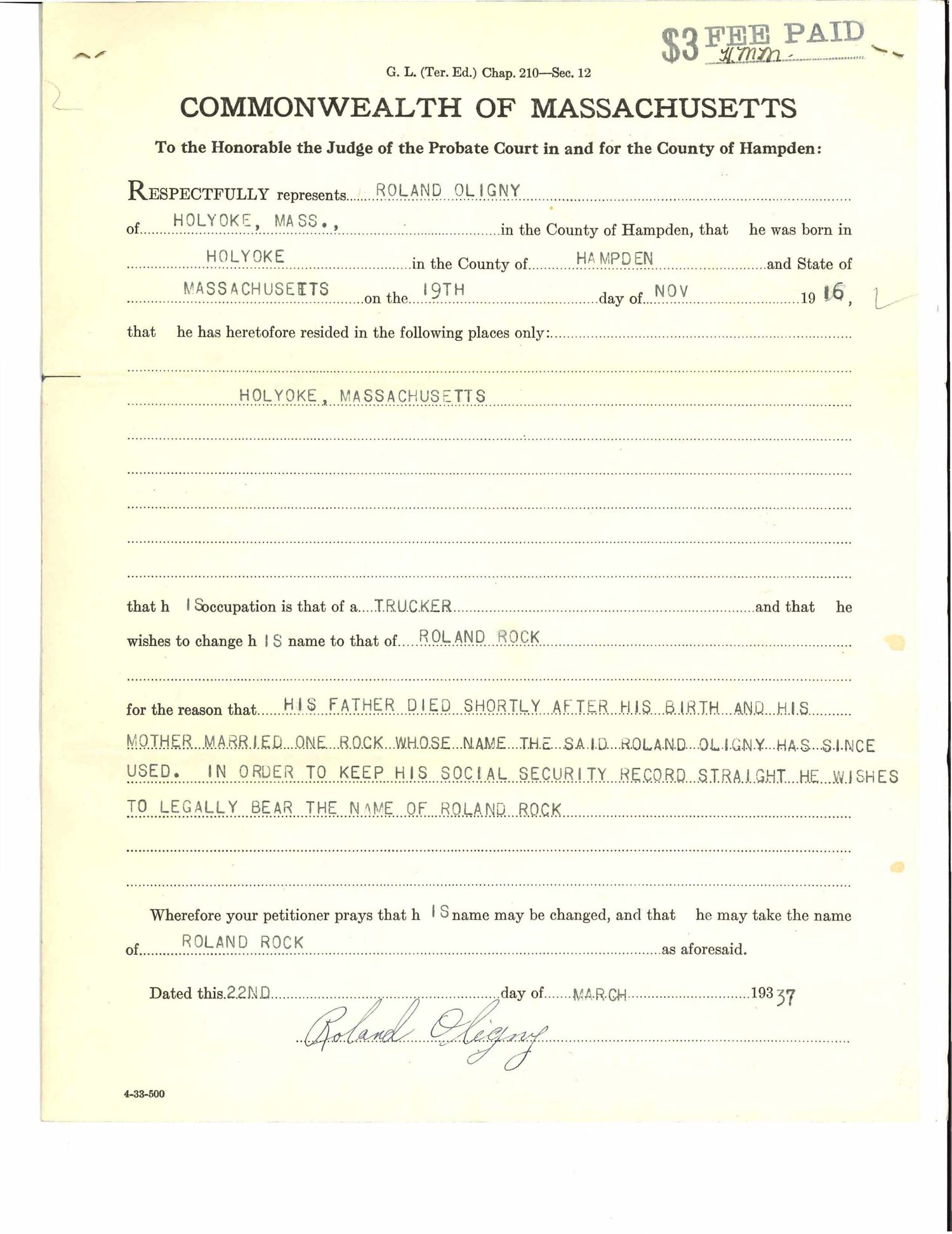
Petition for change of name, Roland Oligny to Roland Rock — sworn 22 March 1937, Hampden County Probate Court, case no. 68419. PROVEN as to the proceeding — and three of the statements inside it are not true.
Read down the form and three separate statements on it are untrue. The date of birth is entered as the nineteenth of November 1916 — he was born in 1915, which the Holyoke birth register settles and which his own Social Security application had given correctly a hundred and ten days earlier. Asked where he had “heretofore resided,” the form answers Holyoke, Massachusetts and nothing else, when the 1930 census and his own school record both put him in Chicopee. And the reason paragraph, quoted above, is false on both of its claims. All three are typed into the blanks like any other answer — not argued, not explained, just filled in. The signature at the foot is Roland Oligny, the name being given up.
It is the second half of a pair, and the form above is the record this one says it exists to straighten. Nothing in the file suggests the court looked behind any of it: the citation ran three weeks in the Holyoke Daily Transcript and Telegram, no one appeared, and the decree was allowed outright on 23 April 1937. Why this site shows some documents and not others.
Petition, citation, and decree, Change of Name of Roland Oligny, Hampden County Probate Court, case no. 68419 · docket 23, p. 10 · recorded vol. 244, p. 298 · allowed 23 April 1937 · graded Proven as to the proceeding; the stated death of the father, the sole-residence recital and the 1916 birth year are each contradicted by other evidence on this page — documented falsehoods within the source, not claims of this site
February 1938: a wedding, and a third answer
Ten months after the decree, on 22 February 1938, Roland married Helena Castree Williams at the Skinner Memorial Chapel in Holyoke. He was twenty-two and gave his occupation as machine operator; she was twenty, at home, daughter of Benjamin Williams and Helen Castree. Both were marrying for the first time, both born in Holyoke. The Rev. Ronald J. Tamblyn officiated, entered on the return as clergyman.
Line 11 of that certificate asks for the name of the groom's father. It reads Gideon.
Line 12 asks the maiden name of his mother, and gives Mary Ann Saurette — Marie-Anna, anglicised the same way everything else in this family eventually was.
Certificate of Marriage, City of Holyoke, 22 February 1938, registered no. 35, intention no. 22 · graded Proven
The hinge is December 1936
Put the documents in order and the question of whose son Roland was has a date on which the answer changes. It is not the name change, and it is not the wedding. It is the month before he petitioned.
Step-son, surname Oligny. The census of Chicopee enumerates Irene and Roland in Gideon's household under their birth surname, the relationship entered plainly.
Father: Philorum Oligny. On his Social Security application he names his own father, by the middle name the man went by. This is the last document in which Roland claims Joseph — and the last in which he is, by his own account, an Oligny.
His father died shortly after his birth. The sworn petition, three months later. Joseph was alive in Lowell and had twenty-nine years to live.
Father: Gideon. On his own marriage certificate, ten months after the decree, he names the man who raised him — not as stepfather, not with any qualifier, simply in the space the form provides for a father.
Father: born in the United States. Roland falls on a census sample line, so the enumerator asked where his parents were born. The household answered US for his father — Joseph was Canada-born and living — and Canada for his mother, which is correct. This records what the household said. It is not a decree, and nothing here treats it as one.
A son. Gideon's obituary lists "three sons, Roland of Holyoke, Donald and Richard," and a daughter, Mrs. Irene Tetreault. Nothing marks two of the four as another man's children.
Read forward, the shape is unmistakable and it is not gradual. In December 1936 Roland names Joseph. From March 1937 onward, across a court petition, a marriage certificate, a census and finally somebody else's obituary, Joseph does not appear again. Whatever the petition's false sentence was for, it marks the point after which one man stopped being his father in the paperwork and another started.
What the documents cannot tell us is whether that was a decision, a family habit, or simply the easier thing to write on a form. No adoption record has been located, and none of these is one.
1930 U.S. Census, Chicopee · Social Security NUMIDENT, December 1936 · probate case no. 68419, 1937 · Holyoke marriage certificate no. 35, 1938 · 1950 U.S. Census, Holyoke · obituary of Gideon J. Rock, October 1961 · graded Proven as to what each document records; the reason for the change is Unproven
Two doors down
By April 1940 Roland was twenty-four, living on Franklin Street in Holyoke with Helena and an infant son. He worked as an elevator operator in the tissue mills, fifty-two weeks that year for $992. Two households along the same street, at number 307, the census finds Gideon J. Rock, barber, fifty-four hours a week; his wife Anna; their sons Donald and Richard; and Irene, back under her mother's roof as Collins Irene, a cashier in a retail furniture store, with her five-year-old son Bruce.
That October he registered for the draft. The card gives his address as 3 Franklin, his age as twenty-four, and asks for the person who will always know where he is. He wrote: Mrs. Helena Rock — wife.
The trades keep moving. Trucker in 1937, machine operator in 1938, elevator operator in 1940, and by 1950 a press operator in a forge factory, still in Holyoke, still a few doors from his mother.
1940 U.S. Census, Holyoke Ward 6, E.D. 2–116, sheet 12B · WWII draft registration, serial 1220, order 871 · 1950 U.S. Census, Holyoke, E.D. 19–85, sheet 10 · graded Proven
1944: eight months in uniform
A packet from Roland's daughter Faith adds his wartime service to the record for the first time — nothing before this held more than the bare word “veteran” from his own 1998 obituary. He entered active duty on 29 March 1944 at Fort Devens, twenty-eight years and four months old, and was discharged just over eight months later, on 6 December 1944, under a dependency provision: a wife and young children at home outweighed the Army's need for him. He served as a Technician 5th Grade, Supply Clerk, qualified Marksman on the M1903 rifle and Sharpshooter on the carbine. His own enlisted record states it plainly: battles, engagements, skirmishes, expeditions — none; decorations — none; wounds — none.
What came immediately before the uniform may be the more interesting find. His own separation record gives twelve years, to 1941, as a receiving and shipping checker at Stevens Arms Co. in Chicopee Falls — a span that doesn't square with the rest of this page. Twelve years back from 1941 is 1929, when Roland was thirteen — and the same separation record has him at Chicopee High School until 1931. Three contemporary documents sit inside that span and not one of them is Stevens Arms: his December 1936 Social Security application gives his employer as American Tissue Mills, 12 Crescent Street, Holyoke; the 1937 name-change petition calls him a trucker; his 1938 marriage certificate, a machine operator. So the twelve years were not continuous. That much is settled. What they actually were is not: the figure may be a rounding on a form filled in at demobilisation nine years after the fact, or it may cover broken stretches at Stevens Arms around other work. This project does not pick between a form Roland signed and three documents that predate it. What the record does establish cleanly is the year after: final inspector, making “necessary repairs to Lee-Enfield rifle[s] following final inspection.” The Lee-Enfield was a British Commonwealth service rifle, not standard U.S. issue — meaning Roland's own civilian employer was very likely already filling an Allied wartime contract before he was ever called up himself. The Army made him a supply clerk; it was not a large step from the shop floor he'd already been standing on. It also sits comfortably beside his 1998 obituary's “quality control inspector for 33 years at Moore Drop Forge Co.” — a working life spent almost entirely around industrial inspection, war or no war.
The same packet gives a physical description of Roland that exists nowhere else in this project: blue eyes, brown hair, medium complexion, five feet nine and a half inches. And one small discrepancy, logged rather than quietly corrected: his own separation paperwork, in his own hand, gives his birth as 19 October 1915 — a month off the date four other sources agree on, including the draft card he'd signed four years earlier. Read as a slip on a benefits form, not a live question about the actual date.
Separation Qualification Record (WD AGO Form No. 100), Roland A. Rock, signed 6 Dec 1944 · Enlisted Record, serial 31 459 189 · Certificate of Honorable Discharge · Register 01 §3.47 · graded Proven
The rest of it
Three photographs survive, from other branches of the family, and two of them are shown below. In one, autumn 1947, he sits in a wooden chair in Irene's kitchen at 672 High Street in a full suit and tie while his sister, heavily pregnant, stands beside him in a housedress — the clothes alone tell you he was visiting. In another, October 1965, he is forty-nine and seated beside his mother on her seventy-fifth birthday, with Irene on her other side and Donald and Richard standing behind. The family's own caption calls them her four children. In a third, undated but almost certainly from later in the 1970s, he sits beside his mother again, both visibly older than the pair in the 1965 photograph — he in a cream tuxedo with a white boutonnière, wedding-guest formal wear, she in a plaid dress. Likely a family wedding, consistent with her own death in 1979.
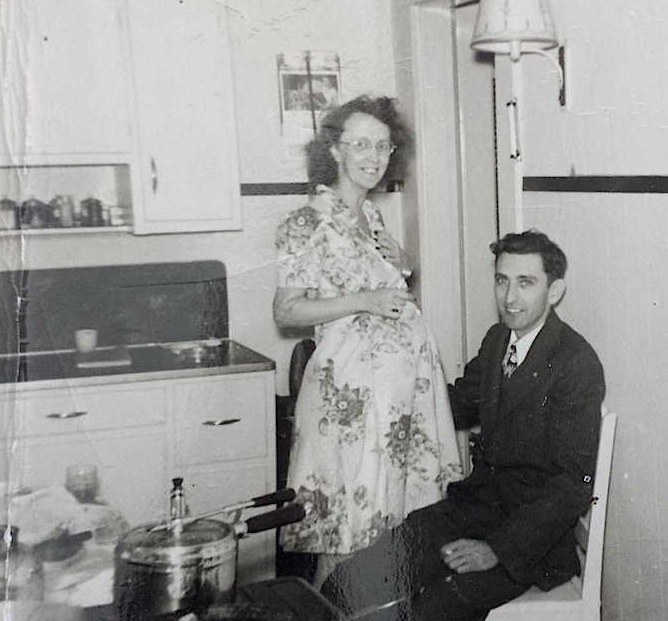
Irene and Roland in the kitchen at 672 High Street, Holyoke — autumn 1947, by the family’s caption. PROBABLE
What the frame shows is one thing; what the caption says is another, and they are graded apart. The room, the clothes, the canner on the stove, the pregnancy and the crease across the print are simply there to be seen. That the woman is Irene, the man Roland, the room hers, the season autumn 1947 and the child she is carrying her second, Bernard Tetreault — that is the family’s caption, carried with the print when another branch of the family shared it, and it is family testimony: consistent with everything else this site holds about the two of them, and unverified by any document. The clothes alone say he was visiting.
Digital image of an original print, shared through another branch of the family; the print itself is creased and edge-worn, so it lived in an album or a drawer before it was scanned. Nothing has been retouched.
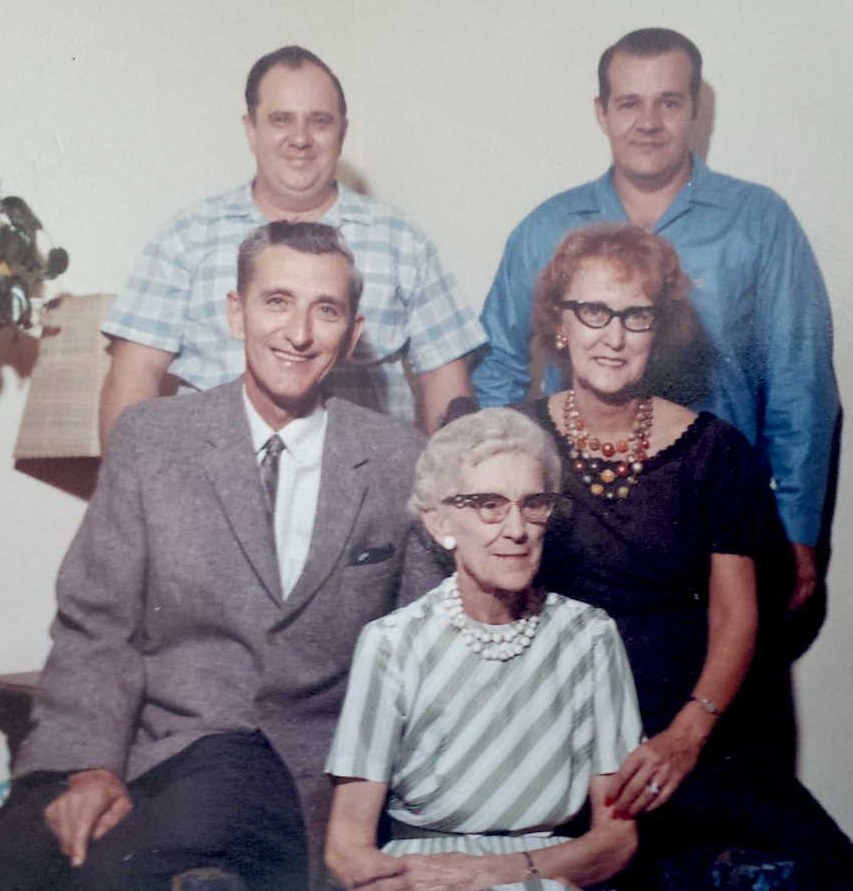
Marie-Anna Saurette on her seventy-fifth birthday, with her four children — October 1965, by the family’s caption. PROBABLE
The caption reads, in full: “Maria Anna on her 75th birthday with her four children: Irene, Roland, Donald and Richard.” It is a modern family attribution and is graded as one. But one part of it stands on a sighted act rather than on memory: Marie-Anna was born on 1 October 1890, on her baptismal act at St-Jean-Baptiste-de-Rouville, so a seventy-fifth birthday in October 1965 is exact, and the ages that follow from it fit every face in the frame — Roland forty-nine, Irene fifty-two, Donald about thirty-eight, Richard thirty-six. Roland is the seated man in the grey suit and Irene the woman in black; which of the two standing men is Donald and which is Richard, the caption does not say, and neither does this site.
Four children is the family’s own count, and it is right: Irene and Roland from her first marriage, Donald and Richard from her second. The two marriages that produced them are on the page that follows Holyoke. Digital image of an original colour print, shared through another branch of the family. Nothing has been retouched.
He died on 29 October 1998, having outlived his mother by nineteen years and his father by thirty-two.
Family photographs, 1947 and 1965, shown above, and a third, undated (later 1970s), described only · Register 01 S66, S67, §3.44 · Social Security NUMIDENT · the death is graded Proven; what each photograph shows is read directly, and the captions — the dates, the place, the names — are family testimony, graded Probable
Where the two lines actually meet
Everything else on this site runs toward the wedding of 1912. Roland is what came out of it. Every shared ancestor this project has found between his parents — Marguerite Doucinet, Élisabeth Gobinet, Mathurine Desbordes — he carries twice over, once down each side, because Joseph and Marie-Anna each descended from all three without knowing it.
The Desbordes case is the strangest. Roland descends from her through his father, by way of Jeanne Guiberge; through his mother, by way of Suzanne Bouvier; and the man who raised him and gave him his surname descends from her too, through Suzanne's other son. Three separate paths out of one seventeenth-century woman, and by 1937 all three were in the same household.
Marriage and baptismal acts throughout, sighted at every joint of all three descents — they are set out generation by generation on Mathurine Desbordes’s own page. The top joint of the Oligny-side path is the marriage of her daughter Jeanne Guiberge to Pierre Cabazier, Notre-Dame de Montréal, 23 July 1669, sighted · Common Ancestors §5(ii) · Register 01 §3.30a(iii), §3.30d · graded Proven
One thing on this page is recorded inconsistently and is left that way rather than tidied: the birth register's full name, Roland Lawrence, never appears written out again in his life. The name is anomalous well beyond this page: across 22,299 individuals in this project's files, Lawrence occurs exactly once — here — against Laurent 138 times and Laurence five. The bare initial does appear, once, eighty-three years later — his own 1998 obituary heads him Roland L. Rock, which is a relative's account to a newspaper rather than anything he ever wrote. Whether that's Lawrence quietly resurfacing at the end or an unrelated initial nobody today can account for is left open; see After Holyoke for the fuller name sequence.
There is one more piece, and it comes from inside the household rather than from paper. Roland's own son Robert, asked directly where Lawrence had come from, had no idea. That is first-hand testimony to an absence, from a man who had every reason to know, and it is the closest thing to a negative this kind of question ever gets. It does not establish where the clerk got the name in 1915. What it establishes is that the name was not in use in the family a generation down — which is what all four documents already implied, now said by someone who was there.
Family testimony, recorded for this project in 2026 — Robert, son of Roland, on the origin of Lawrence · Register 01 §3.48(iii) · graded Probable as testimony, and testimony to an absence rather than to a fact; it corroborates the documentary record and does not stand alone
It is tempting to read 1937 as the moment a French name ended. It isn't quite that. Gideon Rock's own father was born Gédéon Noël Thouin dit Roch at Mascouche in 1852, and Rock is what became of Roch after it crossed into Massachusetts. Roland did not trade a French name for an English one. He traded one French name for another that had already been through the same thing a generation earlier, on the other side of the border — and this page stops there, where the living family begins.