Marie-Anna Saurette
b. 1 October 1890, St-Jean-Baptiste-de-Rouville — d. 13 May 1979, Massachusetts. The bride at the center of this whole project: the 1912 marriage that brought the Saurette and Oligny lines together, a decade after both families had already crossed into the same corner of Massachusetts.
Crossing at seventeen
Marie-Anna was the third of seven children born to Alméric Saurette and Alida Morier, all of them born at St-Jean-Baptiste-de-Rouville. She crossed into the United States with the whole family on 8 December 1907, at the port of Swanton, Vermont — seventeen years old, the family settling in Holyoke, Massachusetts.
Manifest, Port of Swanton, VT, 8 Dec 1907 · graded Proven
A mill operative, and a marriage now sighted on the original
Marie-Anna married Joseph P. Oligny at Holyoke on 30 May 1912 — the marriage record itself has now been sighted directly, on both the clerk's certificate and the city's bound register, rather than relied on secondhand as earlier accounts of this family had to be. Both were entering a first marriage: he twenty-two, a casemaker; she twenty-one, listed on the certificate as a mill operative — the first industrial occupation recorded for a woman anywhere on either family's direct line, in either country, in three hundred years of records. Five years off the boat, she was earning her own wages in a Holyoke mill.
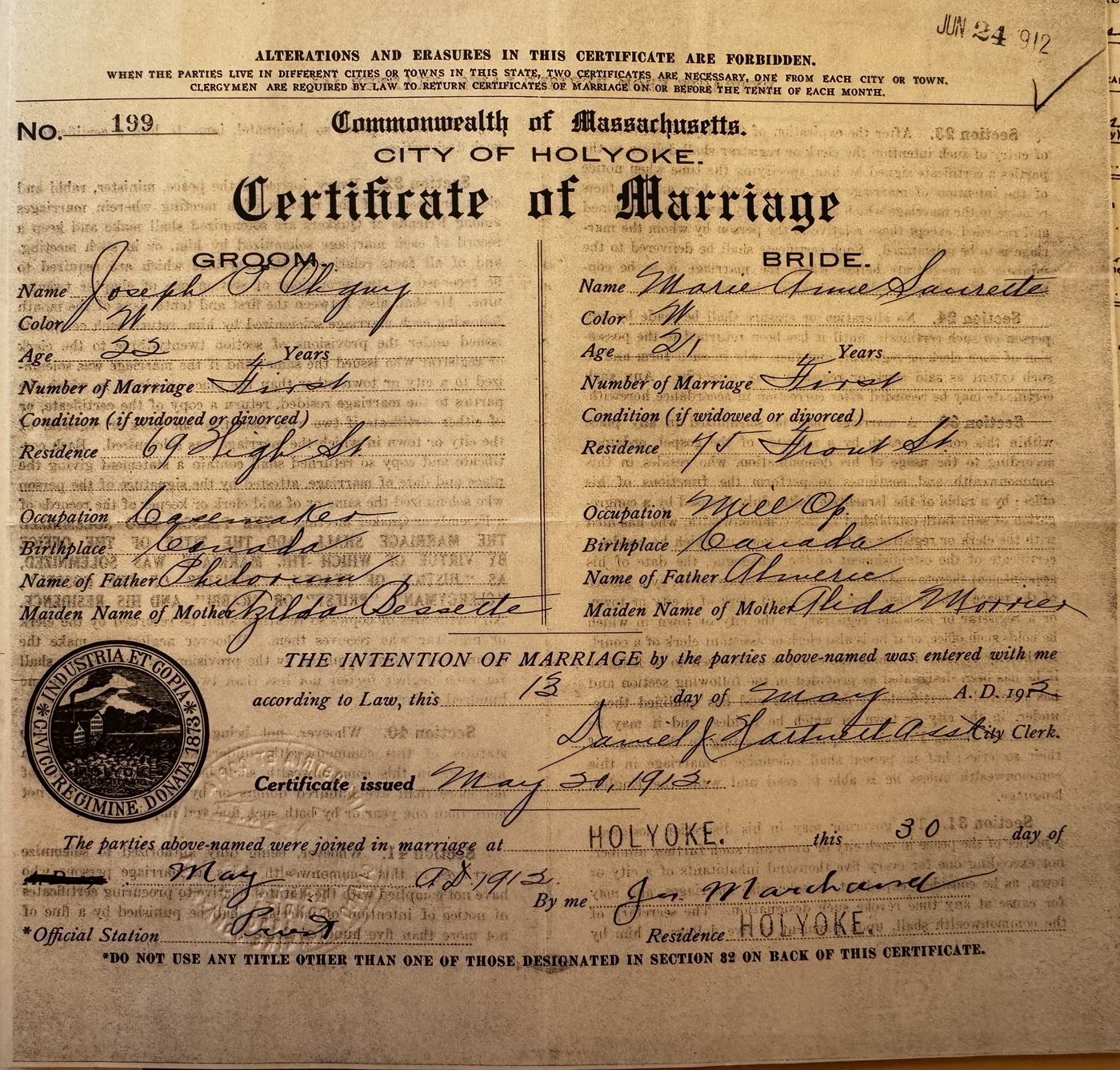
Certificate of Marriage no. 199, City of Holyoke — the wedding this entire site is built around. PROVEN as to the marriage itself.
Both are entering a first marriage — the column reads First twice, which is what independently makes the Lowell marriage Joseph’s second. Her occupation is entered Mill Op. and his Casemaker, a trade he left within three years for the paper mills. The intention was entered on 13 May before assistant city clerk Daniel J. Bartlett, the certificate issued on the 21st, and the return stamped into the record on 24 June — the date in the corner.
And it does not name a church. Asked where the parties were joined in marriage, the certificate answers HOLYOKE — the city, and nothing more. Everything in the paragraph below about the parish and the building comes from elsewhere and is graded Probable for that reason. This is what a grade looks like when you can see the gap it is measuring. Why this site shows some documents and not others.
The church is now known, and naming it took fifty-three revisions of this project's own evidence register. They married at Notre-Dame du Perpétuel-Secours, Holyoke's French-Canadian parish — and not in the church most people picture when they hear the name. Louis Caron's building on Chestnut Street, modelled on the village churches of rural Quebec, was not dedicated until October 1922. Joseph and Marie-Anna married in the plain five-function structure of 1891 that stood before it, and Roland was baptized in the same room. The witnesses were Victor Leclerc, of whom this project knows nothing whatever beyond the name, and Alméric Saurette — her own father, who would stand witness at four of his daughters' weddings between 1912 and 1924.
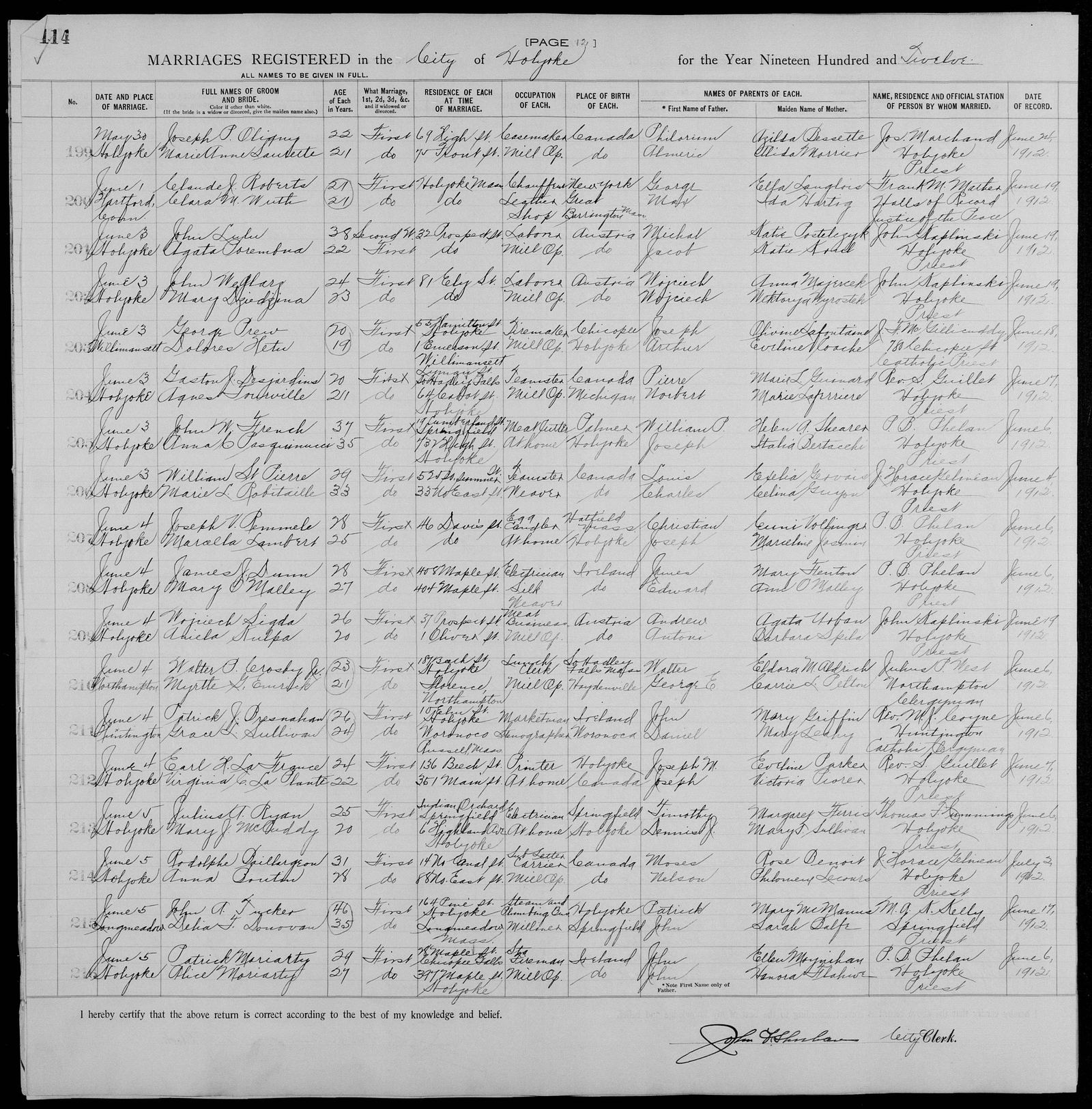
The same entry in the city’s bound register — Marriages Registered in the City of Holyoke for the Year Nineteen Hundred and Twelve, page 114, entry 199. PROVEN
This is what “sighted on the original, twice over” means. The clerk’s certificate above and this ledger row are two separate original records of one event, written by different hands into different books, and they agree field for field. Neither is a transcription of the other.
It is also the only place on this site where the family appears as a line in somebody else’s list. Entry 199 sits at the head of the page; eighteen more Holyoke marriages from the first days of June run underneath it, and the occupation column beside them keeps returning the same two words. Marie-Anna’s Mill Op. is the first industrial occupation recorded for a woman anywhere on either family’s direct line in three hundred years of records — and on this page it is unremarkable.
Certificate of Marriage no. 199, Holyoke, 30 May 1912, sighted · published parish répertoire, Notre-Dame du Perpétuel-Secours, marriages 1890–1991, compiled — the entry is identified as this couple not by name but by two birth dates, hers 1 October 1890 and his 9 June 1889, each Proven independently on a sighted act · parish histories for the building, secondary · Register 01 §3.49(i) · graded Proven as to the marriage itself; the parish, the witnesses and the building graded Probable
1916: a petition, a conviction, and a stated intention
In July 1916, Marie-Anna filed a petition against Joseph in the Hampden County Probate Court — case 39079. What she filed was a petition for separate support, a distinct Massachusetts remedy that orders money and settles custody without ending a marriage; an old account of this family, printed before the underlying record was directly examined, described this as a divorce outright, which the record does not support.
The order of that month matters, and the file finally makes it legible. She signed the petition on Monday the 17th. On Tuesday the 18th, Joseph was convicted of assaulting her and sentenced to three months. On Thursday the 20th, a newspaper item recorded her stated intention to pursue a divorce as well as separate support, for herself and their two children, Irene, three, and Roland, eight months. She filed the petition on Thursday the 27th — nine days after the conviction, a week after the newspaper. The paperwork was written and signed before the assault case was heard; what she actually lodged, in the end, was the narrower remedy and not the divorce she'd told the press about.
The form gives her ruled lines for specifications — the particular grounds — and she left them blank. Desertion and non-support, and nothing further. No decree is recorded against the docket: the Allowed line, the recording volume and page, and the draft decree in the file are all blank. Whether the court granted her anything is not shown by the file itself. What is settled is that the marriage did not end in 1916 — she filed again, on different grounds, five years later.
Separate support case file no. 39079, Hampden County Probate Court, petition dated 17 Jul 1916, filed 27 Jul 1916, docket 33 p. 116 — sighted · newspaper notice, 20 Jul 1916 · graded Proven as to the petition, its dates and its pleading, and as to the conviction; the stated intention to divorce is Proven as a statement, not as a completed action; no decree is evidenced
The marriage did not end cleanly in 1916
Three years after that petition, in April 1919, Marie-Anna and Joseph had a third child, Marie Lucile Doris — born the third and died fourteen days later, of pneumonia. Not to be confused with Lucille, the daughter Joseph had years later with his second wife, Léonida Perreault; different mother, different decade, same family habit of reusing a name. A child born in 1919 to a couple whose separate-support case was filed in 1916 is itself the clearest evidence that whatever the 1916 crisis was, it did not simply end the household on the spot. The 1920 census still finds the family together, Joseph, Marie-Anna, Irene, and Roland, all under one roof.
One thing about that child is a genuine puzzle, and it is a puzzle made of an absence. She is not in the register of Notre-Dame du Perpétuel-Secours, where her brother and sister were both baptized. That register records emergency baptisms explicitly — baptism at home by a godmother, ceremonies supplied afterwards; a hospital baptism with the ceremonies dated later — so a parish that records those would have recorded hers. Her absence is therefore a change of parish rather than a gap in the paperwork, and the household had in fact moved, to 66 High Street by April 1919 from 75 Front Street in 1913 and 1915. Her burial is not in doubt: Notre-Dame Cemetery, South Hadley Falls, 19 April 1919. It is her baptism that is somewhere else, and the next parish to ask is Immaculate Conception.
Published parish répertoire, Notre-Dame du Perpétuel-Secours, Holyoke, baptisms 1890–1991, compiled — cited here for what it does not contain · Holyoke birth and death records, 1919 · Register 01 §3.49(vii) · graded Proven as to the birth, death and burial; the absence from this parish graded Probable, and its reading as a parish change rather than a recording gap Probable
Birth and death records, City of Holyoke, April 1919, and 1920 U.S. Census · graded Proven
The divorce, found: docket 1673
Marie-Anna filed for divorce herself, at Hampden County Superior Court, on 18 March 1921 — a full case file, sighted directly rather than pieced together from an index. The libel names conduct dated to on or about 30 August 1920: cruel and abusive treatment, and gross and confirmed habits of intoxication. It names Irene and Roland as the two children of the marriage and asks for their custody. A decree nisi was entered on 5 July 1921; under the standard six-month wait it became absolute on 5 January 1922, certified to the day by the clerk of the Superior Court at Springfield the following morning. The docket jacket's own note, “Finished February 6, 1922,” is the case being cleared a month later, not the marriage ending. Custody of both children was awarded to her outright. One line on the printed decree form was left unused: the option to restore her maiden name is struck through and blank. She left the courtroom still Anna Oligny. Sixteen weeks later, on 27 April 1922, she married Gideon J. Rock at the Municipal Building in Manhattan, before a deputy city clerk — entered under that same name, Anna Oligny, and handing across the counter the Springfield certificate as her proof that she was free to marry. A civil ceremony rather than a parish one, which fits: her first husband was still living, and the Church would not marry a divorced Catholic without an annulment. She gave her occupation on the affidavit as Spinning — the mill work this page has always described, here naming the job.
Divorce case file, Anna Oligny v. Joseph P. Oligny, Hampden County Superior Court, docket no. 1673, libelled 18 March 1921 · graded Proven
New York City Clerk marriage licence file no. 10891, 27 Apr 1922, Manhattan — affidavit, licence and officiant's return, sighted · Certificate of Divorce, Hampden ss., Superior Court at Springfield, certified 6 Jan 1922, filed in the same licence file, sighted · Register 01 §3.30f · graded Proven
Not the same case as 1916
It would be easy to read this as the 1916 petition finally reaching its conclusion five years late. It isn't. The 1916 filing was a petition for separate support, pleaded on desertion; this 1921 libel pleads cruelty and drink, dated to the year before it was filed — a distinct crisis, not a delayed resolution of the first one. The same lawyers carried her through both: Stapleton & Stapleton represented her in 1916 and again in 1921, five years apart.
Hampden County petition, case 39079, 1916 · divorce case file, docket 1673, 1921 · graded Proven
Two husbands, both cousins, neither of them knowing it
One further thing this research turned up, worth sitting with: both of Marie-Anna's husbands were her own blood relations, through two entirely separate lines of descent neither family had any way of tracing at the time. Joseph Philorum Oligny was her half eighth cousin through Mathurine Desbordes — half meaning they share one ancestor rather than an ancestral couple, because his line descends from Desbordes by her marriage to Pierre Guiberge and Marie-Anna's by her later marriage to Michel Bouvier — and, through two entirely different ancestresses, Marguerite Doucinet and Élisabeth Gobinet, a closer seventh cousin once removed, the relationship the convergence tells in full. Gideon Rock, her second husband, was also her seventh cousin once removed — through Desbordes alone, with no Doucinet or Gobinet connection of his own, but by a whole descent rather than a half one: his line and Marie-Anna's both run through Desbordes' daughter Suzanne Bouvier and her husband Louis Brien, a couple rather than a single woman. Two marriages, two husbands, both closing back on the same small colonial pool this family had been drawing from for two hundred years. The Desbordes connection alone is remarkable on its own terms — see Mathurine Desbordes, reached by three completely independent chains: one to Marie-Anna herself through her mother's Morier and Gaboury line, one to Joseph through her first husband's family, one to Gideon through her second. See the shrinking marriage pool for how this pattern runs through both family lines.
Common Ancestors §5 and the set-intersection re-run of 29 Aug 2026 (Desbordes figures: Joseph Philorum at nine generations, Marie-Anna at nine — half eighth cousins, Desbordes entering the intersection as a single individual and not as a couple; Gideon at eight generations, one closer than Marie-Anna's own nine, seventh cousin once removed, a whole relationship measured through Suzanne Bouvier and Louis Brien) · Common Ancestors §3 (Doucinet/Gobinet figure: Joseph Philorum at nine generations, Marie-Anna at eight, seventh cousins once removed — separate, unrelated ancestresses from Desbordes) · graded Proven
Marie-Anna and Gideon Rock had two children together, Donald and Richard, alongside Irene and Roland from her first marriage — the 1930 census records all four under one roof in Chicopee, Irene and Roland still enumerated by their birth surname. She died 13 May 1979, recorded on her own death certificate as Anna M. Saurette Rock, and is buried in St. Rose Cemetery, South Hadley, beside her second husband.